Showing posts with label Techniques. Show all posts

Saturday, January 20, 2024

Whittling the WIP Stack --- the Velvet Hippie Earth Mother Skirt

It's been too long since I actually sat down at the sewing machine and made a thing to wear, lol.  

But, as it happens, I have a stack of things I have started ...some really an embarrassingly long time ago...and I just need to clear the Work In Progress stack.

So I started with the velvet earth mother skirt. When I left it...just a little under 11 months ago, gulp, I had finished the yoke with the pockets.  I decided to cut out each tier, sew it up, and then cut the next one, to avoid mixing the pieces up (one of the previous Hippie Earth Mother Skirts may have had that problem...).  

So, today I finished cutting the first gathered tier, and sewed it on, then I cut and assembled the second tier and have it sewn on, although I do need to serge the seam to finish the edges.

I did tackle my cutting schematic to see if I could do wider, and fewer, tiers, but my fabric was 2" too narrow for that to work.  I have to use the narrow tiers to be able to use up the fabric efficiently.

Which means...5 tiers, with each tier 1.5 times the volume of the one above it...the hem is going to be something like 330" around.  Yeesh. Fortunately, for a velvet, the fabric is fairly light.

I made a casing for a drawstring, just in case it's too heavy for the elastic, just the same.

So, anyway, I shall be gathering for a bit, lol.

When doing something so bodacious and hefty, I use dental floss to gather ... Zigzag over it, 


Then pull the dental floss and secure the ends.  This is waxed, which means the gathers aren't terribly inclined to slip once I've got them arranged...but it's kinda stiff, so I do pull it out after the seaming is all done.

That's just a little tedious, lol.

Not sure when I will finish this; likely not in time to wear it this season as 1) all the fancy events are behind us and 2) even though our high was in the teens today, we'll be pushing 70 in a week.  We're likely done with winter at that point, based on historical trends.  But I'll be ready for  any holiday parties that arise in 2024, lol.


Monday, September 25, 2023

A Quick Reminisce on sewing a Lace Dress...

 Late last Thursday night, as I was nearing the finish line, I commented something to My Sweet Babboo about the craziness it has been sewing three out of the four Mother Of The...dresses.  The Rayon Maxi dress had zero drama,  but the other three...oy, there was drama.  With the first one...it was just my own bone-headedness, which included things like twisting the dress before I sewed in the invisible zipper.  Then there was the Aunt Lena Quasimodo dress I made for the Flute Player's wedding...but I am blaming those problems on the fabric.

Rayon crepe is bad enough when it's cut meticulously on grain.  Cutting it cross grain, which I had to do because of the orientation of the print, just was hopeless.

And that brings us to the black lace dress...

My first problem was probably that I picked the wrong pattern.  I picked a really fitted sheath dress...

Here's the pattern, which I actually purchased because I was smitten with the jacket:

The reviews I had read of this dress looked to have very nicely fitted shoulders/ upper chest.  Bingo.  I'd just leave those vertical darts out and maybe add a bit of width and I should be good to go, right?

Nope.  LOOK at the curves in that dress.  

I. Am. Not. Curvy. Like. That.

I had to straighten out the hip curves considerably after sewing up the first muslin and seeing the poufs I had. The second muslin was better but I probably would've gotten along MUCH better if I had just started with a less shapely pattern.

And, to be honest, I probably should have just made a black sandwashed silk dress and used the lace for a duster coat.  Although I probably would have needed more lace fabric; I had bare inches of scraps left over after all was pieced up and done. 

But...back to  my lament to My Sweet Babboo about the drama.  He just looked at me and said, "Why?"

And that pulled me up short.  Why DID I do that to myself?  Well...I hated to drop what would likely have been $250 bucks on the MOTG dresses I was eyeballing.  (I got that lace at a significant sale price) And those RTW dresses were 100% polyester.  My dress was poly lace over sandwashed silk, lined by rayon bemberg.  Much nicer than just being wrapped in plastic.

And it fit.  I think that was the biggest thing.  The dress fit ME.  

And for some strange reason, I just wanted to tackle a lace dress.

You know,  I learned a lot.  I'd never really tried this type of construction before.  The Flute Player saw the dress just before it was finished...and gasped.  'How long did that take you???' 

'A lot longer than I expected,' I replied.  Then she spotted a scrap of the fabric and looked at it closely.  'OH!  The fabric has the little dangly leafs.  I thought you sewed all those on!'

Well, no wonder she was shocked, lol.

I have come to the conclusion that there must be a lot more engineering in the couture world; I think they must either engineer the patterns so that the seam lines hit the fabric just so or engineer the fabric so that it accommodates the pattern.  Each of the little leaf motifs is sort of framed by scroll work and  I ended up with several small void places...where I had to trim out the motif to sew a seam but there wasn't enough room to replace a motif in the now much smaller framed area after sewing the seam.  Granted, it's not obvious with the black background but if you look closely you can spot them.  And I just don't see any way to avoid that...unless the math was done before hand. But that would be way over my head, lol. 


If you look close, you can see that I'm sewing down a motif that I had to trim away from the only conventional seam on the whole lace overlay.  I just trimmed one side off, sewed the seam, and then tacked the loose side down.  It overlaps the scroll work a bit but from a distance...on the black background...it doesn't show. 


But here's a repeat of a picture from an earlier post.  The void spots jump out with the white background; there isn't room to attach a motif without overlapping another motif, which is lumpy.  Fortunately they are not nearly so obvious with the matte black silk.

 One of the things I learned... I am NOT a couture-level seamstress.

I *did* finish and it *did* look just fine and either no one noticed the void spots or they were polite enough to not mention them, lol.   And, should a suitable occasion arise, I will happily wear it again. Assuming, of course, that it still fits at that point, lol.

Unfortunately, aside from the windblown picture I posted Saturday night...I don't have any pictures yet. 

But now...I have a HUGE mess in my sewing room.  It is staggering how many little motifs are EVERYWHERE.  On the cutting table.  On my sewing machine table.  On the ironing board.  All OVER the floor...I can't believe I cut that many off.


And I did manage to throw a bunch of them in a little box as I was trimming, so ...crazy.

I have a dress to hem for a friend's daughter before I pull the black thread out of the machines.  Gonna pin that up on Wednesday and sew it whilst My Sweet Babboo is off primitive camping this weekend. 

So...I'll do that, and I'll clean up all the little leafy scraps.  Gotta come up with something creative to do with those...somewhere down the line...

Saturday, February 23, 2013

Challis Hints

Gaylen asked for some tips on sewing Challis; I'm not going to pretend to be an expert but I'll share what I've learned...

For sewing rayon in general, check Shannon Gifford's sewing guide at Emma OneSock .  I thought she had written a guide for challis, but I didn't find one.  So here's my two cents' worth.

First, make sure you pick a pattern that is compatible with an uber drapey fabric. Think loose, blousey, soft.  This is not a fabric from which to make a pencil skirt. ;-)

Challis shrinks; be sure to pretreat it.  Sometimes the dyes are not stable; I ruined a very nice new top by putting it the same cold water wash as a new piece of (admittedly cheap) rayon challis.  So wash it cold by itself.    I usually run it through the dryer, too, the first time, although I will drip dry the finished garments.   Rayon feels very stiff and woody when it's wet; don't panic, that's a function of the fabric (also a way to know it's really rayon...).  It will soften again when it's dry.

Actually constructing the garment is an exercise in patience; challis can't be rushed.

Challis is very unstable, which means it is a PITN to cut.  A helpful hint here:  spray starch.  That will help stabilize the fabric so that it doesn't slide off grain or distort.  Press and starch the fabric immediately before laying on the table.  Also using a cutting mat and rotary cutter will help lessen the distortion when cutting out the pattern.

Once the pieces are cut, handle them as little as possible to keep them from distorting.  The fabric is fragile at this point.  It will ravel; zigzag or serge the seam allowances after a seam is sewn.

(This is important!) Mind the direction of the stitching; always sew from the wide end to the narrow end; sew slowly and avoid pulling on the fabric as much as possible.  I don't pin much, but when I'm sewing challis I will use pins to make sure the seams feed evenly and don't shift.  Pin on the seam line (put the pin in perpendicular to the seam; in and out of the fabric right where the seam will cross).  Hand basting can also be your friend here.

If your garment is a bias cut, allow extra seam allowance width and sew with a very  narrow zig-zag

I know all of this sounds very tedious and picky, but a well-sewn challis garment falls beautifully and feels very feminine.  Be careful and don't hurry and you should be fine.

I have a gored rayon skirt with godets that I thought I could sew right up; the gores all went whopperjawed and none of the seams were the same length (those bias edges really distorted).  I unpicked the whole thing, pressed it carefully back into shape, and restitched, paying attention to direction and such and it actually fit together and is one of my favorite summer skirts.   Wish I'd been more careful the first time...

So, there's my limited wisdom on sewing challis.  If anyone else has any tips or suggestions, please leave them (or links to them...) in the comments!   Gaylen and I will both appreciate it. ;-)

Thursday, October 04, 2012

Squaring Up

A while back, I threw a silk scarf panel into one of my online fabric orders.  It was ten bucks, and I thought it would be a good opportunity to practice my hand rolled edges.  One of the very first classes I took from Cynthia Guffey was her hand stitching class, and it included a marvelous technique for doing hand rolled hems.  Of course, it has taken me 8 years to get around to actually trying it...

The first step, though, is trimming the scarf panel down.  There was actually a little  void in the weave indicating where the panels were to be separated; that I can tell you it is there indicates that the fabric was NOT cut on the mark.  So I measured the narrowest bit of border and discovered that I needed to trim that black down to 2 1/4". 

Here's a tip I stumbled across...the panel was somewhat wrinkled when I laid it on the table, so I thought it would be smart to iron it out smooth before I tried to cut it to exact edges.  However, I found that the wrinkles were very stubborn...and I was afraid my steam iron would leave waterspots.

So, I quickly gave the panel a very gentle bath in some cool water and baby shampoo, blotted it with a towel and began to iron it again.  But I noticed that, damp, it didn't slip around nearly as much as it did dry.  Inspiration hit, and I laid the damp scarf out on my cutting table and trimmed it down.  MUCH easier to work with!

I took one of the long scraps to practice the hand stitching.  I didn't exactly remember how it was done, so I did an internet search for techniques, thinking I'd spot something similar.

Nope.  Not so much.  So I dug out my binder with my collection of Expo notes and found the notes I'd taken in the class.  Played around with it a bit and saw what I had to do to make it work, technique wise.  But it was tricky to do it by guesstimate;  all the tips recommend machine stitching a guide on the fold line.  I had skipped that step to just practice the technique itself

So I took one of the scraps to the sewing machine and stitched a line 1/4 inch from the edge so I could see if having a stitched line as a guide made a difference.
 
But, when I sat down to actually roll and stitch the edge, I was alarmed to see a very subtle, but noticeable, pull line at every single stitch.  So I pulled out a brand spanking new needle (60/8 Universal), stitched a bit on the other strip and...got the same thing.  The Universal needles apparently are not right for this fabric, and the smallest Microtex needle I have is  an 80/12, which I think would be much too large for the silk.  So I'ma gonna do what I did on the first sample and carefully eyeball that baby at 1/4" and see how it goes.  I just can't see putting those pull lines in my scarf...

'Cause I intend to start on it tomorrow; The Artist has managed to damage his knee again and will be having a bit of a procedure to try and correct it once more.  This is a minor outpatient arthroscopic deal, but we will still be at the surgery center for 4ish hours.  I expect to get a good bit of scarf hemming done while I'm waiting...

Thursday, May 26, 2011

Whack-A-Seam

I'm looking forward to a long weekend with (hopefully) a few moments for sewing and blogging.

I've got some pictures stored up for future posts, but can't seem to get time to write 'em up.

Meantime, I'm nickle-and-diming my way through the Jalie jeans jacket; it's been on my ironing board now for several days waiting on me to sew the sleeve seams so I can switch thread for the next batch of topstitiching.


I have real concerns about whether or not my little New Home will power through the bulk of the inset seams/pocket/pocket facing/ pocket flap/etc on the front yoke seam and have been pounding it with the clapper when I find myself in the vicinity.

I definitely will have some comments about the processes on this jacket when I get it finished and reviewed. ;-)

Wednesday, February 09, 2011

Hm...Directional Sewing?

I had some time a week or so ago to get to the jacket muslin that's been in the queue for absolutely ages, and I noticed something that I thought was worth a mention.

Notice that the shoulder seams line up nicely on the right shoulder, and are totally wonky on the left:


The only culprit I can think of is that I stitch-marked the seam allowances before I sewed the pieces together, and I sewed the shoulders one way on one side and the other way on the other one, so that one side stretched and the other didn't.

I won't be stitching unstabilized pieces on the actual jacket, but it was interesting to see such a definite illustration of one of Cynthia Guffey's concepts!

Friday, February 06, 2009

Beyond the Directions

Gwen asked a question on today's Friday Confession post that I found I couldn't properly answer within the confines of a reasonable comment, so I'm posting it here today:

When sewing, do you stick pretty faithfully to the instructions or are you quick to throw them out the window and follow your own path? If the later, were you always this way, or did you slowly grow into it as you gained experience? And does the way you approach sewing mirror the way you approach other things in life?

I used to be a completely by-the-pattern-guide kind of seamstress. I mean, I have been taught well to Follow the Directions. I remember sewing disasters and near-disasters, and the only comment I could make was 'Well, that's the way it SAID to do it!' Doing something different never crossed my mind.

Sometime in the Mid '80's I wanted to duplicate a detail from a pair of Liz Claiborne pants that I had purchased at a ridiculous clearance price and loved...the zipper was in the pocket. No ugly topstitching to worry about, no added bulk to the tummy area. I thought it was a great idea. The problem was, I could *not* find a pattern to show me how to do it.

Oh, I found some patterns that had the opening in the pocket, but it was just a finished-off edge. A little drafty, and I more than once put a Kleenex in my pocket and saw it fall out of my pantleg a few minutes later. But that was all I could find instructions for. I made do.

It wasn't until around 2002 that it occurred to me that it didn't matter if I did the zipper 'right' or not...it's in the pocket! No one will see it! So, I devised a method of inserting the zipper in the pocket...and even used a zipper that didn't match the fabric, just because it was what I had on hand.

I had an epiphany with that project...I really *could* do things my own way! Why do things like the patterns say? The objective is NOT to Follow the Directions, but to have a nice-fitting, nice-looking garment in the end. Now, I use the Pattern Guide as a general idea of how to put a garment together...but I may or may not do it as instructed. If I know a better way, you better believe I will do it that way.

I hadn't thought about that as an approach to life in general...but you know, I probably do look for ways to do things better, adapt instructions to fit my particular 'skill set' (isn't that a great term? I just heard it applied to my abilities last week...). Most of the time, it's a good thing, but every once in a while I go too far out on that limb and have to scramble back to safe ground (and usually make some apologies on the way).

All in all, though, it was an esteem boost to realize that I had enough knowledge and skill to do something on my own...and that gave me enough confidence to try some things I would never have tried. So, unless we're dealing with an Absolute Authority, I will adapt and modify 'bout anything if it looks like a better way.

Saturday, July 19, 2008

The Lightbulb Goes ON

Every once in a while. something does click in this ol' brain of mine. It finally clicked on a better way to cut out patterns when I read Kathleen Fasanella's post on rotary cutting yesterday.

One of my grumbles about cutting is pattern erosion...the little nicks and slices that seem to happen no matter how hard one tries not to do that. It's especially bad on the costuming patterns, because we're moving in such a hurry.

Obviously, the answer is to chalk-trace the pattern onto the fabric and then take it away before cutting.

Duh.

I don't even think it will take much longer to trace it than it does to anchor it down...particularly after I've had a bit of practice....

Now, where'd I put that chalk?

Tuesday, January 15, 2008

I am *Such* a Weenie

The next thing on the Queue is the Chopin Blouse. Another sort of Edwardian silhouette with high collar, full sleeves, long cuffs and peplum shaping. It's a fussy blouse, with shirred over panels on both the collar and cuffs. I've made it before, but I skipped the shirring, just cut the under collar/cuff pieces on the bias for the upper collar/cuff.

I'm still skipping the interesting horizontal pockets; I think they'd get lost on the striped fabric. But this blouse is going to have the shirred pieces...the upper collar/cuffs are cut on the bias, about twice the height of the under collar/cuffs, and shirred in three places to a paper template, then narrow strips of fabric (which have been folded in thirds to enclose the raw edges) are top stitched over the gathering. Finally, the paper template is removed and the upper collar/cuff is sewn RST to the under collar/cuff and turned right side out. Proceed as normal.

I've decided I'm going to tackle that bit of the blouse first...get the fussy stuff out of the way...and I'm dragging my feet. I'm not particularly patient w/fiddly stuff; as a Sanguine, I'm way more into fast-and-furious git 'r done sewing. But I *want* this blouse, it'll be fabulous. So I'm a little frustrated with my whiney foot dragging.

Especially after seeing Summerset's final 'Midnight Garden' photos (if you haven't seen them yet, click on that link. NOW. And click on her photos to enlarge them so you can see the details.) She imagined that outfit, then did all of that embellishment...from the silver quilting to the hand appliqued flowers to the individually stitched beading on all the edges. She embossed the velvet and created the little lace cricket. There are details on the lining you can't see. She started and stopped and rethought and redesigned elements more than once in the process. And she finished by her deadline. It's not garment sewing...it's art. And it's amazing.

So how can I fret about a little fiddly shirring in the face of such an epic of couture level sewing?

I will not have a car today, so I'm At Home until this evening. By golly, I'm going to get those shirred pieces done...

Monday, December 10, 2007

Chained!


But unlike Marley and Marley, it's a good thing. (Ok, that link did originally go to a photo of Michael Caine as Ebenezer Scrooge with Statler and Waldorf as Jacob and Robert Marley, from A Muppet Christmas Carol, but Disney apparently doesn't allow direct image links; the URL is right but it only goes to the Disney homepage. Bummer.) I had never sewn the recommended chain onto the hems of my Vogue 8043 jackets, mostly because I couldn't find suitable chain. I'd checked at Hancock's several times, even looking in the home dec department for drapery chain but no go. Then I happened to be walking by the jewelry making section of Hobby Lobby last week and noticed that they had metal jewelry findings...including plain chain necklaces...at half price. There were only two chains of any weight and length (I think it was 18") there and I bought both of them. A little twisting with needle-nosed pliers and the clasps were gone and I had one long chain.

Then, while we watched our traditional Christmas movies (Rankin/Bass's Rudolf, Chuck Jones' Grinch, A Charlie Brown Christmas and The Muppet Christmas Carol)last night I stitched the chain into my blue/grey SWAP '06 jacket.

Erica B. is right...that chain makes a great improvement in the way the jacket hangs. I'm just going to have to start watching for those Hobby Lobby sales and stock up on some necklaces...unless someone can tell me where to find the real chain!

Monday, August 20, 2007

Still in the Learning Process

Amongst the costuming, I've been doing a smidgen of work on the Bodacious Queue and I finished up the first item last night...a silk charmeuse version of my modified City Dress shell.
I purchased this fabric at my first-ever Atlanta Expo back in 2004...Louise Cutting had it in her booth and it sang to me the whole time I was there. But at $20/yd I just couldn't see myself getting much. Finally, on my way out on Friday evening (I had to leave on Friday), I stopped to pet it one more time and Louise took pity on me and told me she'd pay the sales tax if I wanted to get one yard for a shell top. I decided to forgo dinner on the road on the way home and I bought it.

Then it came home with me, and I proceeded to do nothing with it, wanting that top to fit PERFECTLY before I made it up. Well, in the Cutting Marathon I decided I'd tweaked that pattern enough and it was time to make the shell. So I very carefully placed the front on w/one of the big roses in the center (I remembered well my lesson in print placement). I wasn't really sure I wanted to do the turn-and-stitch necklline/armhole finish on this lovely silk, but as it turned out, I had enough left to cut some bias strips. So I tried a new-to-me technique: I bound the neck and armholes w/bias strips.


And I learned some things, chief amongst them being that silk charmeuse stretches and skinnies a lot more than I expected. I wanted the binding to finish out at a 3/8" width, so I multiplied 3/8" by 4 and came up with 1 1/2" for the width. Then, to compensate for the 'turn of the cloth' thing, I added another 1/4" and cut the strips 1 3/4" wide.

That still wasn't wide enough. Even though I handled them very carefully, they skinnied out so that I had to use about a 1/8" seam allowance. Which meant I had to unpick all the 1/4"-from-the-edge staystitching I'd done on my top. Which means that I have little perforations visible at very close range. Oh, it'll be under a jacket most of the time anyway...I doubt if anyone looks that close. But still.

Anyway, I sewed the strips into a circle the size of the opening, then folded the WS together and sewed them to the RS of the top, rolled the fold to the WS and hand stitched it down. I didn't press it until it was all done, because I didn't want the wrong fold pressed in.

And, in the above-mentioned fiddling, the neckline apparently stretched slightly (oh, I was careful! Really!) Or maybe it was just hanging up a bit because...it's a shade snug. That's a puzzle, because this is a TNT pattern that has always fit well.

I'm hoping it was just the 'I'm wearing a knit top today' bra that I was wearing (y'know...those foam rubber cups designed to maintain a 'smooth profile' under knit tops? That add girth to the bustline?), but it could be middle age spread ;) No photographer has been available yet, so here's the on-the-hanger view:


Anyway, it's wearable, it's even pretty...it's just not quite the breathtaking garment I was hoping for. But I learned something...so it's ok in the long run, right? ;)

Wednesday, May 30, 2007

'Trixie's' Skirt...Making it Work

Next church costuming project: a skit that will be videotaped and shown during an upcoming service. This is a 40's detective at work (it will be in black-and-white), and we'll all be costumed accordingly.

Which is kinda fun...the 40's is one of my favorite fashion eras. I'm the underpaid wise-cracking secretary, Trixie, so I won't be wearing the fancy suits, but I do get a skirt and blouse appropriate to the era. Yesterday I decided it'd be simpler to just make a new skirt than to try and make one of the skirts currently in the wardrobe work; so I started digging through the pattern stash and the cheap fabric bin to see what I could come up with.

I had three or four reproductions of 40's era patterns, but found that one of them already had the skirt pattern traced and adjusted, so it won the toss...it's an out-of- print Butterick:


I found a yard-and-a bit remnant of black herringbone-weave poly suiting and squeezed the skirt on. Then, when I sat down to serge the edges, I saw the piece that had been cut from the folded-under portion of the fabric had a slight problem ...there was a roughly-quarter circle chunk missing from the upper left front side seam/waistline corner. Aaaiiiieee! Wait, though...it's shaped like a shallow pocket opening! Quick, back to the cutting board. I traced off the cut edge, and used the skirt pattern and the boo-boo shape to draft pocket yokes and facings, then installed them. Hey...it worked! And, bonus...I get a skirt with pockets!

The skirt also had a side zipper; not my favorite zipper installation but I was going to go with it just because I didn't want to take the time to put a CB seam in the little narrow back piece. But, guess what...I had no black zippers. And it was too late for a Hancock's run. Now what...do I finish it to the zipper? But, hey, now I've got pockets! And I had cut the waistband extra-long, just because ya never know, so now I *could* do my favorite zipper installation in the pocket! I removed the serging and the stitching on the inside edge of the left pocket so I could get at the left pocket yoke and stuck a blue zipper there-in. No one'll ever know....

It was a fortuitous circumstance all around.

All that remains is to put a hook/eye on the waistband and hem it. Now I need a blouse. I looked around a bit online at 40's fashions and have two or three blouse patterns that would do just fine, with the right fabric. I really wish I had some black-on-white polka dot fabric in the stash for that, but I don't. Maybe a plain white blouse w/black rick rack trim or something.

I'll puzzle it out while I hem the skirt. ;)

Friday, March 23, 2007

Building Bible Costumes -- Part 2

This is a further continuation of a tutorial began in The Inseam Pocket Tutorial and continued in Building a Bible Costume -- Part 1


After finishing the neckline, sleeves are next. My preference is to go ahead and finish the sleeves and press the hem up before sewing them in...much less fabric to wrestle around on the ironing board, and the hems are easier to press if you do them flat. (TIP: cut strips of a manila folder in useful widths...1", 1 1/4", 1 1/2", whatever you use frequently, label them, and use them as pressing templates. Makes a job like pressing up the hem on these sleeves a quickie!)


Next, sew the sleeves to the garment with a conventional machine, matching notches and shoulder seam/dot. Serge the seams together, or zig-zag them and trim...but only between the dots! (see photo...dots are clip marked). Press the seam towards the sleeve.


Starting at the sleeve edge, sew the underarm/side seam in one continuous seam, being careful not to catch the finished edge of the pocket (if you put a pocket in per the earlier post). Make sure to 1) have the ends of the seam joining the sleeve to the garment stacked on top of each other and 2) stitch on top of that when you round that curve. Serge the edge, trimming the seam to a scant 3/8" wide, and press seam towards the back. (If you're zig-zagging, trim the curve under the arm to 3/8" and zig-zag those seam allowances together, then clip the ends so that you can open the rest of the seam flat; zig-zag those seam allowances singly and press them open.)


Finish the raw edge at the bottom while the garment is flat...you're almost done!


Starting at the clip mark that's about 7" down from the top, sew the back seam all the way to the bottom with a conventional machine (it should be cut on the selvedge). Press that seam open.


Continue pressing the seam allowance to the wrong side above the stitching. If you have some, a little fusible web slipped under the seam allowance and pressed well will anchor it securely. Topstitch from the finished neck edge, down to the top of the sewn seam, across to the other side, and back up...about 3/8" from the fold.


For the closure, after much trial and error, we have found that the quickest, easiest, least distracting closure is to simply sew a bias tape tab at the neckline and use a snap closure to secure it. Start with a piece of single-fold bias about 2 1/2" long, folded in half. Zig-zag it securely to the wrong side of either side of the back (do you really want to debate 'his/hers' on this? Just pick one) at the top of the opening; edge stitch around the edges and along the garment edge to make it very secure.


I have a snap-setting tool to use...just a few taps with a hammer and the snaps are on! But, if you prefer, you can hand sew a snap in place (note to my sewing ladies...if you bring the garment in at this point, I'll be happy to hammer on the snap! ;) )


Here's what the snap looks like finished. Press the hems on the bottom and sleeves (the sleeves should just need a touch-up press at the seam) and topstitch in place.


And here's the finished sack...er, Biblical-style robe... ;). I'll post some info about the extra pieces (drapes, sash, headband) over the weekend.
Tuesday, March 20, 2007

The Inseam Pocket Tutorial

Ok, this is not exactly a generic pocket; I'm writing this up for ladies who are helping me sew Bible costumes; we're adding inseam pockets so that in the event that any of these folks might need a wireless mike at some point in the future, they'll have a pocket to stick the transmitter in... ;)

However, once you realize the placement marks on these pockets can be adapted for whatever other thing the pocket should be added to, then it will apply.


I blatantly copied a Kwik-Sew inseam pocket, which had a mark for the waist. The sideseam notch on the Bible Costume (McCall's 2339) appears to be at about waist level...close enough for costuming, anyway. So, I put a clip at the waistline mark on the pocket to match to the sideseam notch on the garment. There are three clips on the garment...the armsceye notch, the dot where the dropped shoulder seam turns into the side seam, and the side seam notch. The three notches on the pocket are the waistline notch, and the two notches that mark the pocket opening.


On the wrong side of the pocket, draw a line 7/8" from the raw edge between the pocket opening notches. Match the waistline notch on the pocket to the side seam notch on the garment front, then stitch from the raw edge at one opening mark, over to the line you just drew, pivot and stitch down to the level of the second opening mark, pivot again and go straight off the fabric. Go back and, using very small stitches, reinforce the corners by stitching immediately over them for 1/4" or so on either side. Clip into the corners.


Turn the pocket to the inside, pulling the corners out and press it well. Edgestitch it.


Now, lay the second pocket piece over the first, right sides together, and, moving the garment out of the way, stitch around the outer edge of the pocket. If you don't have a serger, straight stitch it first, then go back and zig-zag the edges. Baste the pocket to the garment front within the side seam allowance.
Now you can treat the whole front/pocket assembly as a regular front; you don't have to stop and start at the pocket opening, and there's no danger of the pocket sewn to the front not matching the pocket sewn to the back. (That photo looks like the pocket opening is huge...it really isn't; I think the telephoto distorted it some).

You just have to be careful not to catch the topstitched edge of the pocket opening in the sideseam when you sew the sideseam...but it looks very nice! :)


This can be used on any pattern that uses an inseam pocket. However, unless your fabric is very firm, for a real life wardrobe, fuse lightweight interfacing to the pocket opening area of both the pocket facing and the garment...that helps it keep its shape.

Wednesday, March 14, 2007

Expo 07 Report: Classes

Ok, this is the, um, reason we all go to Expos, right? To be instructed by great and inspiring sewing educators? It's really not buying stuff....

Yeah, that's why this is post number 3 instead of post number 1. Oh, I was saving the best for last. Yeah, that's it :)

Anyway, I started off at 9 on Thursday with Cynthia Guffey in two back-to-back classes; the first was 'Backs Fitting First' and the second was 'Off grain, On target'. Those of you who have had classes with Cynthia will imagine my shock when she came in dressed in blue jeans! And the cutest little princess shell top made of underlined lace (which I am SO going to knock off at the first available moment!). The backs fitting involves two measurements: shoulder slope and upper back curve. I'd seen Cynthia demonstrate this concept last year in the muslin fitting class, but the review absolutely didn't hurt. Miss A and I decided to measure each other's back curve and shoulder slope on our next 'cut for church' day (which is tomorrow...Big Project between now and the first of April; I'll get around to explaining it someday soon). Actually, we were wondering why it didn't occur to us to bring measuring tools and do it while we were there.... The second class was a discussion of fitting curves of the body...most notably, the bust curve. Cynthia's model was a cute gal in her early twenties who, as Cynthia put it, has got curves. Cynthia talked about dart placement, rotating darts, converting a darted style into a princess, converting an armsceye princess into a shoulder princess...I gave up drawing and decided to get the book in which she describes these things ;). But it will make more sense textually after seeing it visually.

The only other class I had on Thursday was Diane Ericson's Fashion Illustration class. It really was a lot of fun, and while I still don't consider myself a great artist, the drawing that I ended up with (beginning with a tracing from a fashion catalog) surprised me. Anyway,for whatever it's worth, here it is,along with the photo I used for inspiration (I would credit the source on it, but I really have no idea where it came from)Um, should I point out that we had no erasers? :D


On Friday, I had Peggy Sager's Jeans fitting class and Louise Cutting's travel wardrobes class. Peggy did a quick little visualization of the difference between Crotch Length (distance from waist to waist through the legs) and Crotch Depth (distance from waist to crotch) that I have never seen before that really illustrated very well that properly adjusting Length does not affect Depth...suddenly, I saw it as cup shaping applied to the rump...that was a real Lightbulb Moment.

Louise's class was chock full of great tips on traveling and personal safety...not something you'd expect at a sewing expo! But, from someone who travels as much as Louise does, it certainly was good advice. She also showed us her 'paper dolls' -- she's done a package of the front views (technical drawings) of all her patterns, one per sheet of paper, all drawn to the same scale. So, using a scanner and a copier, you can create little samples of her clothes in your fabric, or a reasonable facsimile of your fabric (she said to purchase scrapbook paper for a wide variety of colors for solid fabrics) For a solid, run the scrapbook paper through the copier and copy the garment you want to make from that color...then cut it out. For the print, scan the print, then print it on regular paper, then run it through the copier. That really looked like a lot of fun, and I could see that it was an invaluable tool for wardrobe capsule planning (aka SWAP - Sewing With A Plan). But, I didn't have any money for toys this year, and I had to pass it up. But I did get the booklet that went along with the class, and it also has the outlines...although those outlines are in the back on a smaller scale; I may play with those all the same. ;)

On Saturday, I had Cynthia again for two classes, with Tammy O'Connell in between teaching about sewing with leather. I did learn some things in Tammy's class, but I had a hard time staying focused. It was the next-to-last class, on the last day, I'd had a big lunch, the air conditioning was running and humming...and Tammy has a very soft voice, which wasn't helped much by the PA system, which had about a quarter second delay, so there was always a hint of an echo. But, I'll remember her tip about handling small glued bits w/tweezers...that will be a good thing to remember when DD does her science project poster, too ;)

I'd be surprised if anyone had a hard time staying alert in one of Cynthia's classes...even on the afternoon of the last day. Her buttonhole class was great...tips on making good buttonholes on a sewing machine("We're not going to make bound buttonholes; if you came in here to do bound buttonholes you're going to be disappointed"). Her sewing machine makes buttonholes backwards like mine does, and she gave some excellent advice on keeping buttonholes straight on such a set up (I smacked my head...it was so obvious...). The final class was Pants Tweaking; I wore my modified Daphne pants and Cynthia tweaked them. I wondered why I had a diagonal fold behind my knees...turns out the crotch depth was about 1/2" too long and, um, I have a flat butt (That was news to me; I used to always add length...). She pinned out the extra and the class oohed and ahhed behind me, so I'm guessing it was a great improvement. She said the diagonal folds went away; there were no mirrors, so I'll take her word for it. Miss A measured the adjustments for me before I took the pins out, so I have some real adjustments to make to an actual pattern...and it should fit Really Well once that's done. Oh, she also recommended that I stay away from tapered pants (and I had taken some of the taper out of those)... So anyway, between Peggy's jeans class and Cynthia's Pants class, I feel like my knowledge of pants fitting increased exponentially and I can't wait to pull out that Daphne pattern and see what happens... ;)

Monday, January 15, 2007

Sewing Quirks

Once upon a time, many years ago a fair-to-middling seamtress (yes, that would be me), laid a pattern piece erroneously on the fabric and cut the pattern out along the line marked 'place on fold'. Devastated by the ruination of a garment before the first stitch was sewn (I can't remember whether I tried a narrow seam, recut the piece or simply ditched the whole thing...heck, I can't even remember what the garment was. It was a VERY long time ago!), the seamstress decided to leave a paper margin along the 'place on fold line' to remind her 'Don't cut here, Doofus!'

As I was tracing patterns yesterday evening (yeah, still...instead of cleaning the sewing room...) I realized that I *still* do this:

It's so normal for me that I don't even notice it, but when I've traced patterns for, say, Bible costumes and have others helping cut,it has caused some confusion. So I have to explain why the margin is there. It really isn't a problem...the tissue is transparent enough that the fold of the fabric can easily be seen well enough to line the pattern up...but it has gotten me some rather odd looks from fellow sewing enthusiasts.

So I started wondering...does anyone else have any 'weird sewing habits' like that, or is it just me? ;)

Tuesday, October 31, 2006

Hand Basting Blues

Whoda thought I'd spend so much time on a $2 top?

There is a reason that blue fabric was in the dollar pile. It's a BEAR to sew.

But it's a pretty color and it drapes nicely...it's like slinky, only a finer/denser 'nap'. So I'm not only learning about how the Cadeau fits, I'm learning how to tame the wild slinky beast.

The answer is hand basting.

At least, I think it's the answer. So far I have hand basted the neckband together on the outside curve and I have pinned it to the top preparatory to hand basting the band on the top. Hopefully that will hold it well enough that it won't shift and twist when I put it through the serger...and I'm going to try the serger, hoping that the interfacing in the band allows it to actually make a stitch.

If I had a walking foot for either machine I'd use that, but I don't. So I've just got to hand baste, sew slowly and hope for the best.

Well, it's only a $2 top...the real goal is just to see how it fits. So I suppose if I have excessive trouble with ugly seams, if it holds together enough for me to try it on and look it over good it'll be worth the $2.

Dunno if it'll have been worth 2-3 days of work, though ;)

Tuesday, October 24, 2006

The London Shrink


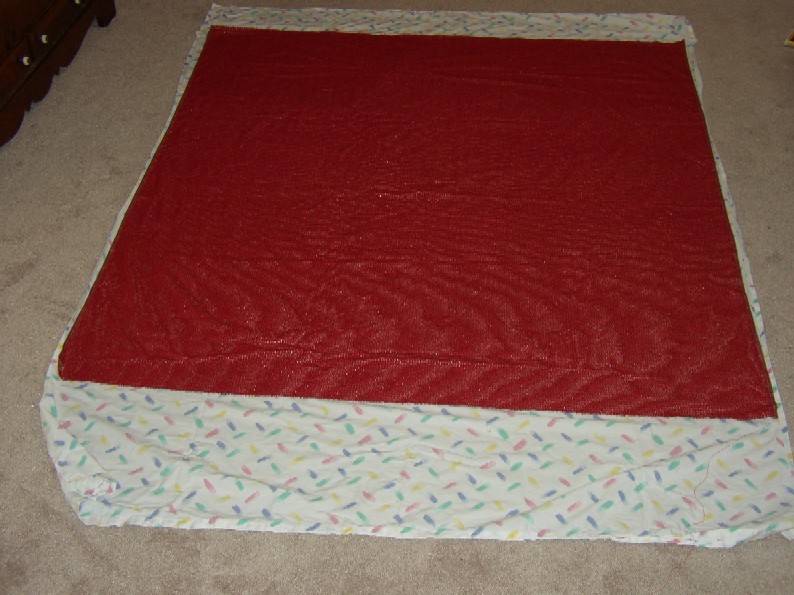
Since I only had 1 3/4 yards of the sparkly red, I decided to prep it by doing the 'London Shrink'
1)run a bedsheet through the 'rinse only' cycle, so that it's damp
2) carefully spread the sheet out, then lay the fabric out flat on it. Roll/fold the fabric and damp sheet together and let them rest overnight.
3) lay the fabric out flat to dry
4) steam press the fabric well, being careful not to stretch or distort the fabric while pressing (I have also read that you should allow each section to dry thoroughly after steam pressing before moving on to the next).

So...I'm at Step 3; I adjusted the pattern last night, taking 1/2" out of the shoulder width at the princess seam and dropping the shoulder height by 1/2". Hopefully, the two adjustments canceled each other out at the armsceye and I should not have to adjust the sleeve, which fits and hangs very nicely.